STR vs Long-Term Rentals in NE Florida

Sep 10, 2024
Tags:Investing
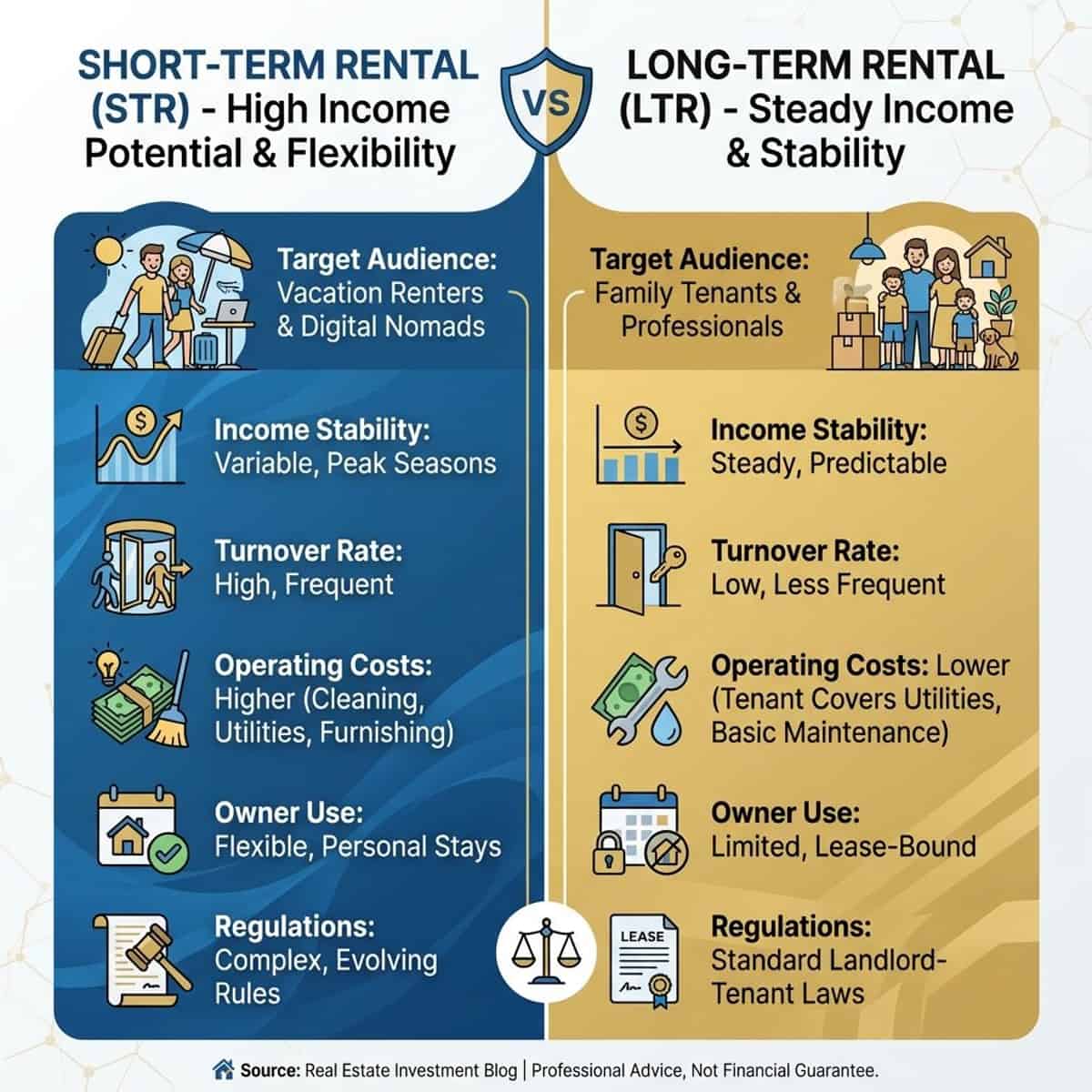
Last Updated: September 2026 – Includes current municipal regulations & Florida Statute § 83 compliance
Thinking about investing in rental property in Northeast Florida? Your first major decision is whether to pursue short-term rentals (STRs) like Airbnb and VRBO, or long-term rentals (LTRs) with traditional lease agreements.
Key Takeaways
Regulatory Divergence: Short-term rentals face strict zoning constraints, DBPR lodging licensing, and 10%–12% state/county tourist taxes (Duval & St. Johns), while long-term rentals (181+ days) bypass hospitality surcharges.
Management Fee Drag: Vacation rental managers typically charge 20% to 30% of gross revenue. Traditional LTR property managers charge 8% to 12% monthly. My standalone tenant placement service charges a single placement fee with 0% ongoing cuts (landlords keep 100% of rent).
Location Strategy: STRs thrive in tourist-permitted zones (St. Augustine historic core and beach corridors), whereas LTRs generate higher net, hassle-free cash flow in suburban hubs (Nocatee, Durbin Crossing, Bartram Park, and Arlington).
Free Placement for Investors: Investors purchasing residential rental properties with me receive complimentary first-year tenant placement.
Both strategies work in Jacksonville and St. Johns County—but the regulations, tax implications, and profit potential differ significantly depending on where your property is located.
This guide breaks down the rules by municipality, compares ROI potential, and helps you choose the right strategy for your investment goals.
Understanding the Basics
What Qualifies as a Short-Term Rental?
In most Florida jurisdictions, a short-term rental is defined as:
- Property rented for fewer than 30 consecutive days
- Rented more than 3 times per year for periods under 30 days
STRs are treated similarly to hotels-requiring licenses, inspections, and tax collection.
What Qualifies as a Long-Term Rental?
Long-term rentals typically involve:
- Tenancy of 6 months or longer (181+ days for tax purposes)
- Standard landlord-tenant law applies
- No hospitality licenses required
- No tourist development taxes
Regulatory Breakdown by Location
In Northeast Florida, municipal ordinances strictly segregate transient short-term accommodations from standard residential leasing. Any residential tenancy under 181 days is classified as commercial lodging, subjecting property owners to 6% Florida state sales tax plus a local 5% (St. Johns) or 6% (Duval) Tourist Development Tax (TDT), mandatory Florida Department of Business and Professional Regulation (DBPR) public lodging licensing, and municipal life-safety inspections. Conversely, residential leases exceeding 181 days operate under the Florida Residential Landlord and Tenant Act (Florida Statute § 83), exempting owners from all tourist surcharges and commercial permitting. Furthermore, over 85% of master-planned community HOAs throughout St. Johns County (such as Nocatee, Durbin Crossing, and SilverLeaf) strictly prohibit leases under 7 to 12 months, making long-term residential leasing the only lawful strategy in suburban high-demand school districts.
The most important factor in choosing your strategy is where the property is located. Let’s break this down by municipality.
Jacksonville (Duval County)
Definition: Property rented <30 nights OR >3 occasions annually for ≤30 days each
Zoning Requirements:
- Commercial and Historic Core zones: STRs generally permitted
- Residential zones (single-family, duplex, townhouse): Require a Short-Term Vacation Rental Certificate
Required Licenses and Documentation:
- Short-Term Vacation Rental Certificate (City Planning Department) – annual renewal
- Land Use Permit (must be filed by property owner)
- Florida DBPR Vacation Rental License
- Local Business Tax Receipt (Duval County) – annual
- State Business Tax Receipt
- Florida Sales Tax Certificate
- Tourist Development Tax Registration
- Fire inspection certificate
Occupancy Limits: 2 persons per bedroom + 2 additional guests, maximum 16 total
Important Note: Jacksonville’s regulations are considered less permissive than some Florida cities due to strict zoning restrictions in residential areas.
St. Augustine (City Limits)
The City of St. Augustine adopted comprehensive STR regulations in 2019.
Zoning-Based Rental Periods:
- RS-1 & RS-2 zones: Weekly rentals minimum (no nightly rentals allowed)
- HP-1 zone: Monthly rentals minimum
- Other zones: Nightly rentals permitted
Required Documentation:
- Annual Short-Term Rental Registration (fees vary by bedroom count)
- Florida DBPR License (Transient Public Lodging)
- Florida Sales Tax Certificate
- Annual Life Safety Inspection by Fire Department
- Proof of liability insurance ($1 million minimum recommended)
- Designated local contact (must respond within 1 hour)
Occupancy Limits: Maximum 12 individuals (2 per bedroom + 2 children under 18)
Parking Requirements: 1 on-site parking space per bedroom (concrete, asphalt, pavers, or gravel surface)
For complete regulations, visit the City of St. Augustine STR Portal.
St. Augustine Beach
St. Augustine Beach has its own distinct requirements:
- Business Tax Receipt required (both city AND county)
- Transient Rental Permit from the city
- Building Department inspection
- Zones permitted: Commercial and Medium-Density Residential only
- Unit cap: 100 STR units in residential zones (limited availability)
St. Johns County (Unincorporated Areas East of ICW)
Unincorporated St. Johns County areas have evolving regulations:
- STR operator registration required
- Guest limits: Maximum 10 guests (phased enforcement)
- Parking, noise, and garbage disposal rules actively enforced
- Tourist Development Tax collection mandatory
- Neighborhood complaints can trigger enforcement
State-Level Requirements (All STRs)
Regardless of location, all Florida short-term rentals require:
- DBPR license if renting >3 times annually for <30 days
- Collection of 6% state sales tax
- Collection of applicable Tourist Development Tax (varies by county)
Tax Implications
Short-Term Rental Taxes
STR operators must collect and remit:
| Tax | Rate | Notes |
|---|---|---|
| Florida Sales Tax | 6% | Collected from guests |
| Duval County TDT | 6% | Tourist Development Tax |
| St. Johns County TDT | 4% | Tourist Development Tax |
| Federal Income Tax | Varies | Net rental income |
Filing frequency: Typically monthly or quarterly depending on volume
Many platforms like Airbnb collect and remit some taxes automatically-verify what’s covered in your area.
Long-Term Rental Taxes
LTR landlords have simpler tax obligations:
- No hospitality taxes (sales tax, TDT not applicable)
- Standard income tax on net rental income
- Depreciation deductions available (27.5 year schedule)
- Property tax at non-homestead rate (no exemption for investors)
For more on rental property tax strategies, see our Tax Deductions Guide.
ROI Comparison
Short-Term Rental Potential
Advantages:
- Higher gross income potential (especially in tourist areas)
- Flexibility to use property personally
- Dynamic pricing during peak seasons
- Potential for 2-3x long-term rental income in prime locations
Challenges:
- Higher operating costs (cleaning, supplies, management)
- Significant seasonality in most areas
- Higher turnover and vacancy risk
- Intensive management requirements
- Regulatory compliance burden
Best locations for STR: St. Augustine historic district (where permitted), beach areas, golf resorts
Long-Term Rental Stability
Advantages:
- Consistent, predictable monthly income
- Lower turnover and vacancy costs
- Simpler management requirements
- Less regulatory burden
- High net yields when paired with standalone tenant placement
Challenges:
- Lower gross income potential than peak-season vacation rentals
- Less flexibility for personal use
- Tenant quality risk (eliminated through rigorous 4-point screening)
- Longer vacancy periods when turnover occurs
Best locations for LTR: Jacksonville suburbs, master-planned communities (Nocatee, Durbin Crossing, SilverLeaf, Bartram Park), and areas near major employment centers.
Management Cost Comparison: The Hidden Yield Killer
When comparing STR vs. LTR profitability, property management fees make or break your bottom line:
| Management Model | Typical Fee Structure | Annual Cost on $2,500/mo ($30K/yr) | Net Impact on Investor |
|---|---|---|---|
| Short-Term Rental (STR) Manager | 20% to 30% of gross revenue | $6,000 – $9,000/year | Covers high-frequency turnover, guest comms, and cleaning coordination. |
| Traditional Long-Term PM | 8% to 12% monthly + leasing fees | $2,400 – $3,600/year | Drains 25%–40% of net annual cash flow on properties requiring minimal ongoing work. |
| Inna Moskalyk Standalone Tenant Placement | Single one-time leasing fee | $0 recurring monthly fees | Keep 100% of your rent checks; full screening, lease drafting, and move-in inspection included. |
Use the interactive rental yield calculator below to compare your long-term rental cash flow and property management fee savings:
Rental Yield & Property Management Savings Calculator
Calculate your gross & net yields and evaluate how much you save using standalone tenant placement vs 10% monthly property management.
7.47%
$33,600/yr gross5.60%
$25,200/yr net cashWith Inna Moskalyk Standalone Placement vs 10% Traditional PM
🌟 Investor Special Offer:
Purchase your next investment property with Inna Moskalyk and receive 100% FREE Tenant Placement for your first tenant.
Best Strategy by Property Location
Coastal/Tourist Areas (STR Potential)
If your property is in a tourist-friendly zone:
- St. Augustine historic district: Strong year-round demand, weekend guests
- Beach communities (where permitted): Premium summer rates
- Golf resort areas: Seasonal demand from golfers
Consider STR if regulations allow and you can handle management intensity.
Suburban/Family Areas (LTR Preferred)
Properties in these areas typically perform better as long-term rentals:
- Jacksonville suburbs: Strong renter demand from professionals
- Master-planned communities (Nocatee, Durbin Crossing): Family renter demand
- Near schools and major employers: Workforce housing demand
Our Jacksonville Rental Market Investment Guide covers specific neighborhoods in detail.
Can You Switch Between Strategies?
Technically yes, but consider:
- STR to LTR: Generally straightforward-remove from platforms, find tenant
- LTR to STR: More complex-verify zoning permits STR, obtain all licenses, may need to wait until tenant lease ends
Some investors use a hybrid approach: STR during peak tourist season, then medium-term rentals (1-6 months) during off-season to traveling professionals or healthcare workers.
Insurance Differences
This is critical and often overlooked:
Short-Term Rental Insurance
- Standard homeowner’s insurance does NOT cover STR activities
- Specialized short-term rental insurance required
- Commercial liability coverage recommended ($1 million minimum)
- Umbrella policy advisable
Long-Term Rental Insurance
- Landlord insurance (different from homeowner’s)
- Liability coverage for tenant injuries
- Loss of rent coverage option
- Generally less expensive than STR policies
Getting Started: Your Checklist
Starting a Short-Term Rental
- Verify zoning allows STR at your property address
- Apply for all required municipal permits
- Obtain Florida DBPR vacation rental license
- Register for sales tax and TDT collection
- Schedule required inspections
- Secure specialized STR insurance
- Designate local contact person (if required)
- Set up listing platforms and pricing strategy
- Establish cleaning and turnover systems
Starting a Long-Term Rental
- Prepare property for rental (repairs, updates)
- Obtain landlord insurance
- Set competitive rent based on market research
- Create tenant screening criteria
- Develop a lease agreement (Florida-compliant)
- Market property and screen applicants
- Complete move-in inspection and documentation
- Establish rent collection and maintenance systems
Florida Statute § 83 Security Deposit & Landlord Compliance
Operating a long-term residential rental in Florida requires strict adherence to the Florida Residential Landlord and Tenant Act (Florida Statute § 83), particularly regarding security deposits (§ 83.49):
- Depository Banking Requirements: All tenant deposits and advance rents must be deposited into a Florida banking institution in either: (1) a non-interest-bearing escrow account, (2) an interest-bearing account (paying the tenant 75% of annualized interest or 5% simple interest), or (3) secured by a surety bond with the county clerk. Funds cannot be commingled with personal operating funds.
- 30-Day Mandatory Disclosure: Landlords must provide written statutory disclosure within 30 days of receiving funds specifying the depository institution's name and address.
- Strict Return and Claim Timelines: At lease conclusion, the landlord has 15 days to return the full deposit if no damages are claimed. If claiming damages, the landlord must issue an itemized written claim via certified mail within 30 days. Failing to send timely statutory notice forfeits the landlord's legal right to retain any portion of the deposit, regardless of property condition.
Calculate exact investment returns with our interactive Rental Yield Calculator, or explore localized landlord solutions in Durbin Crossing Tenant Placement, Nocatee Tenant Placement, and our comprehensive Jacksonville Tenant Placement Services.
Frequently Asked Questions
Make an Informed Investment Decision
Both short-term and long-term rental strategies can succeed in Northeast Florida—but aligning your strategy with local municipal zoning, tax structures, and management overhead is essential for optimal ROI.
Considering a rental property investment in Jacksonville or St. Johns County? Explore our Jacksonville Tenant Placement Services, schedule an Investor Consultation, or read our Jacksonville Rental Investment Guide.
Inna Moskalyk specializes in residential real estate and investor services throughout Northeast Florida, including Jacksonville, Nocatee, Ponte Vedra, St. Johns County, and St. Augustine.