St. Johns Homestead Exemption Deadline

Jun 1, 2024
Key Takeaways
$50,000 Standard Exemption: Deducts up to $50,000 from your home’s assessed value ($25,000 applies to all taxing authorities including schools; $25,000 applies to non-school taxes on values between $50,000–$75,000).
Amendment 5 CPI Indexing: Under Florida's constitutional amendment, the second $25,000 exemption is indexed annually to inflation ($50,722+ exemption baseline for 2025/2026).
Save Our Homes (SOH) 3% Cap: Caps future annual assessment increases at 3% or the Consumer Price Index (whichever is lower), protecting primary homeowners from market-driven tax spikes.
Strict March 1 Deadline: Homeowners must establish permanent Florida residency by January 1 and file their application with the St. Johns County Property Appraiser by March 1.
Last Updated: September 2026 – Includes 2025–2026 Amendment 5 inflation adjustments and SOH portability guidelines
If you’re buying a home in Florida, the Homestead Exemption is one of the most valuable tax benefits available to you. It can reduce your property taxes by hundreds or even thousands of dollars annually-and it’s available to every Florida homeowner who qualifies. If you are preparing to buy a home in St. Johns County or evaluating your net proceeds when selling your current property, understanding homestead savings is essential.
This guide walks you through exactly how the homestead exemption works, how to apply in St. Johns County, and the 2025 updates that make it even more valuable.
What Is the Homestead Exemption?
The Florida Homestead Exemption (authorized under Florida Constitution Article VII, Section 6) is a constitutional provision that exempts up to $50,000 of your primary residence's assessed value from local ad valorem real estate taxes, generating an average annual tax savings of $750 to $1,250 across St. Johns County and Duval County. To qualify, you must hold legal or beneficial title to the property and maintain it as your permanent residence as of January 1 of the tax year. Beyond the upfront tax reduction, filing locks in the vital "Save Our Homes" cap, which restricts future annual assessed value increases to a maximum of 3% or the CPI rate, whichever is less. All applications must be submitted to the St. Johns County Property Appraiser (Eddie Creamer) by March 1 along with proof of Florida residency.
The Florida Homestead Exemption reduces the taxable value of your primary residence, directly lowering your annual property taxes.
Here’s the basic breakdown:
- First $25,000 exemption: Applies to ALL property taxes (including school district taxes)
- Second $25,000 exemption: Applies to assessed values between $50,000-$75,000, but only for NON-school taxes
So if your home is assessed at $75,000 or more, you receive the full $50,000 reduction in taxable value for non-school taxes, and $25,000 for school taxes.
2025 Amendment 5 Update: More Savings
Starting January 1, 2025, Amendment 5 introduced annual inflation adjustments to the second $25,000 exemption.
For the 2025 tax year, the inflation-adjusted exemption amount is $50,722 (instead of flat $50,000). This amount will be recalculated annually based on the Consumer Price Index.
What this means for you: Additional savings that grow each year as the exemption keeps pace with inflation.
How Much Can You Actually Save?
Let’s run the numbers with a realistic St. Johns County example:
Scenario: $450,000 Home Tax Breakdown
| Valuation & Tax Category | Without Homestead | With Florida Homestead | Net Exemption Benefit |
|---|---|---|---|
| Assessed Value | $450,000 | $450,000 | $0 (Baseline Assessment) |
| Taxable Value (School District) | $450,000 | $425,000 | -$25,000 (First $25K Exemption) |
| Taxable Value (Non-School / County) | $450,000 | ~$399,278 | -$50,722 (Full Exemption + Amendment 5) |
| Estimated Total Annual Taxes | ~$5,850 | ~$4,850 | $800 – $1,200 / year in Direct Savings |
Using St. Johns County’s millage rates, annual savings typically range from $800–$1,200 depending on your specific taxing district (e.g., St. Augustine vs. Ponte Vedra vs. Northwest St. Johns County).
Over 10 years of homeownership, that’s $8,000–$12,000 in direct savings—and that’s before factoring in the compounding Save Our Homes 3% annual assessment cap.
Save Our Homes: Long-Term Tax Stability
The Homestead Exemption unlocks another powerful benefit: the Save Our Homes (SOH) Assessment Cap.
Here’s how it works:
- Your assessed value can only increase by 3% annually OR the Consumer Price Index change (whichever is lower)
- Market value can skyrocket, but your assessed value stays capped
- The longer you own, the bigger the gap between market and assessed value
Real-World Example
You bought your home in 2020 for $350,000. By 2025, the market value has increased to $500,000.
Without Save Our Homes, your assessed value would be $500,000.
With Save Our Homes, your assessed value might only be $395,000 (capped at 3% annual increases).
That’s over $100,000 in value that’s NOT being taxed. At typical millage rates, this saves you $1,500+ annually compared to a new buyer at the same property.
Portability: Take Your Savings When You Move
Planning to move within Florida? Portability lets you transfer up to $500,000 of your accumulated Save Our Homes benefit to your new home.
How Portability Works
- Calculate your “portability amount” (market value minus assessed value)
- Apply this reduction to your new home’s assessed value
- File within 3 years of establishing new homestead
Portability Filing Deadline
You must file for portability at the same time you file for homestead exemption on your new property-by March 1st of the year following your move.
This is critical for buyers relocating within Florida. Don’t leave money on the table by missing this deadline.
Eligibility Requirements
To qualify for Florida’s Homestead Exemption, you must:
- Be a permanent Florida resident (not just a snowbird)
- Own the property as of January 1st of the tax year
- Occupy the property as your primary residence by January 1st
- Not claim residency benefits in any other state or county
What Disqualifies You?
- Maintaining a driver’s license in another state
- Being registered to vote in another state
- Filing taxes as a resident of another state
- Renting out the property as a primary use
- Using the property primarily for business
How to Apply in St. Johns County
Online Application (Recommended)
The St. Johns County Property Appraiser offers a streamlined online portal:
- Visit sjcpa.gov/exemptions
- Create an account or log in
- Complete the application with required information
- Upload supporting documents
- Submit and wait for approval
Online applications with complete documentation are typically processed quickly.
In-Person Application
St. Johns County Property Appraiser’s Office
4030 Lewis Speedway, Suite 203
St. Augustine, FL 32084
Phone: (904) 827-5500
Bring all required documents with you to avoid multiple trips.
By Mail
Download Form DR-501 from the Florida Department of Revenue website and mail to the St. Johns County Property Appraiser’s office with copies of all required documents.
Required Documents Checklist
Gather these before applying:
- Social Security Numbers for all owners listed on the deed (and spouses)
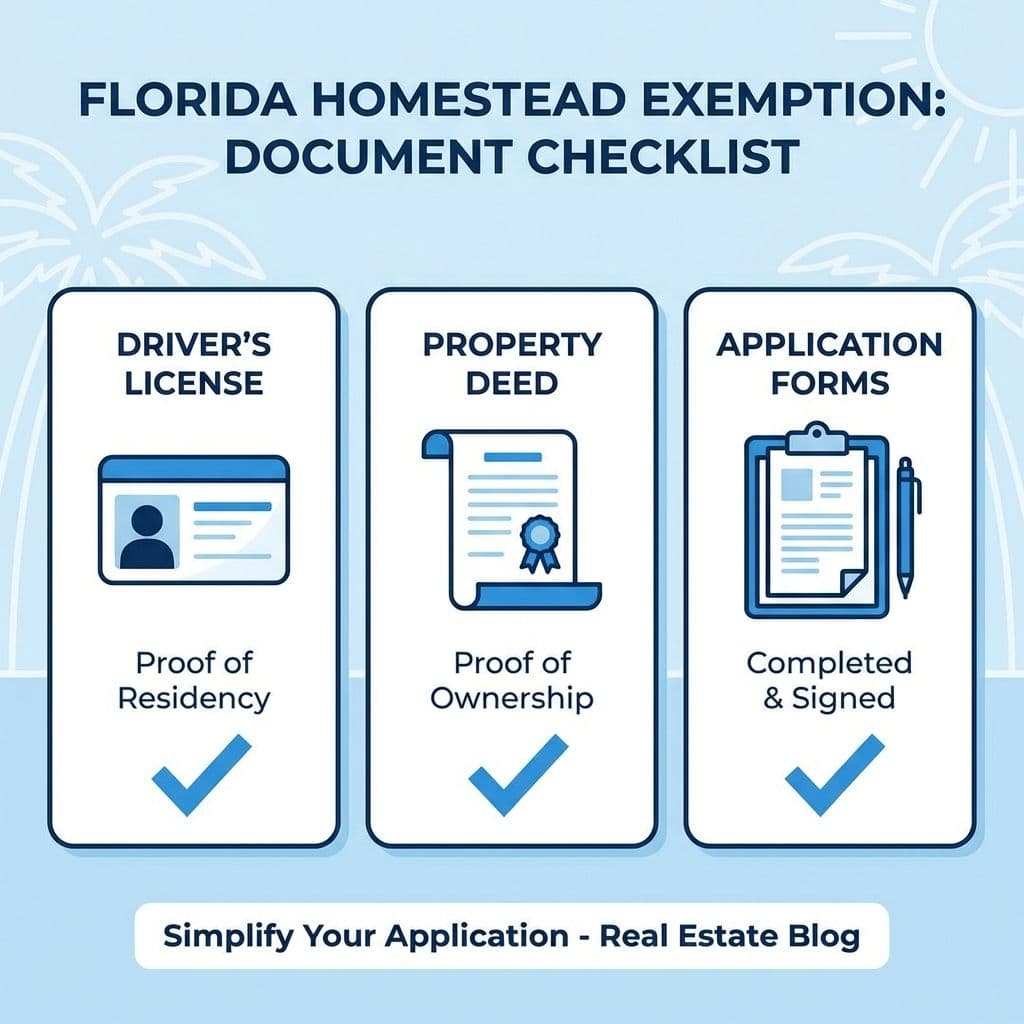
- Florida Driver’s License or ID showing the homestead property address
- Proof of permanent Florida residency (one of the following):
- Florida voter registration
- Florida vehicle registration
- Declaration of Domicile filed with the Clerk of Court
- Green Card (if applicable for non-US citizens)
- Recorded deed showing your ownership
Pro tip: Update your driver’s license and vehicle registration BEFORE applying. The Property Appraiser will verify your address matches.
Important Deadlines
For 2026 Tax Year
| Filing Milestone | Key Date | Strategic Guidance |
|---|---|---|
| Timely Filing Opens | March 4, 2025 | File early once permanent Florida residency is established by January 1. |
| Timely Filing Deadline | March 2, 2026 | Official statutory deadline (first business day following March 1). |
| Late Filing Available Until | September 18, 2026 | Extension under Florida Statute § 196.011 for extenuating circumstances. |
Filing during the “timely” period ensures your exemption is applied without complications. Late filing is possible but may require additional documentation.
Just Bought a Home?
If you purchased after January 1st, you won’t qualify for that tax year’s exemption-but file immediately for the following year. Many people wait too long and miss the deadline.
Do You Need to Reapply Every Year?
Generally, no. Once approved, your homestead exemption automatically renews each year.
However, you DO need to notify the Property Appraiser if:
- Your marital status changes
- Ownership of the property changes
- You begin renting part of the property
- Your residency status changes
- You’re specifically contacted by the Property Appraiser’s office
Additional Exemptions You May Qualify For
Beyond the standard homestead exemption, St. Johns County offers:
Senior Citizen Exemptions (Age 65+)
Additional exemption amounts may be available based on household income limits. Contact the Property Appraiser for current thresholds.
Veteran Exemptions
Various exemptions available for:
- Veterans with service-connected disabilities
- Surviving spouses of veterans
- Combat-wounded veterans
Disability Exemptions
Florida residents with permanent disabilities may qualify for additional exemptions.
Frequently Asked Questions
Beyond Homestead: Federal Tax Deductions
While homestead exemption reduces your Florida property taxes, you may also benefit from federal tax deductions. See our Tax Season Real Estate Deductions Guide for information on mortgage interest deductions, SALT caps, and more.
New to Florida Home Buying?
The homestead exemption is just one piece of the puzzle when purchasing a home in St. Johns County. Make sure you understand:
- Florida Closing Costs – What to expect at the closing table
- First-Time Buyer Guide – Step-by-step buying process
- Mortgage Calculator – Estimate your monthly payment including taxes
Need Help With Your St. Johns County Home Purchase?
Understanding property taxes and exemptions is important-but finding the right home comes first. Contact me for a buyer consultation and I’ll guide you through the entire process, from home search to filing your homestead exemption.
Inna Moskalyk is a St. Johns County real estate expert helping buyers navigate the Florida home buying process. Serving Ponte Vedra, Nocatee, St. Augustine, and Jacksonville.