Florida Buyer Closing Costs: St. Johns Guide

Jan 10, 2026
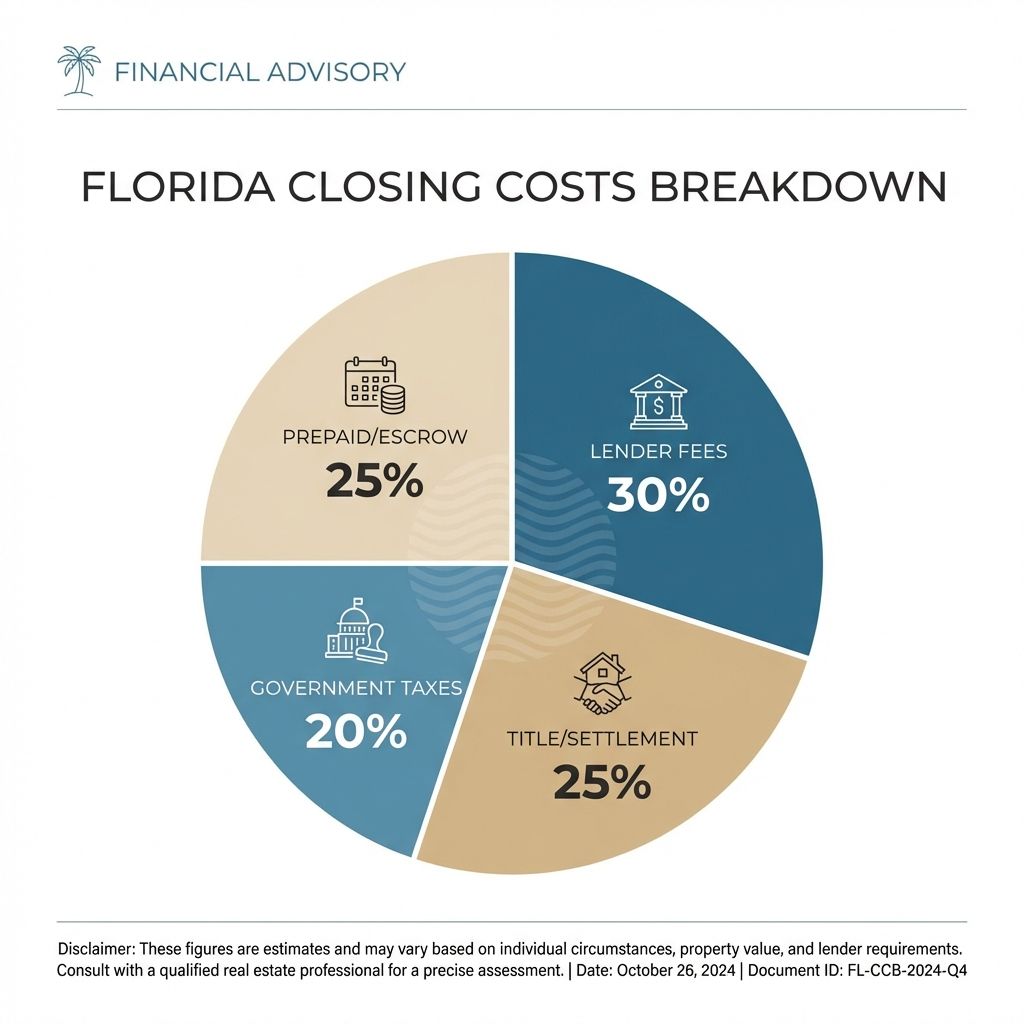
Key Takeaways
Total Cost Benchmark: Florida homebuyers using financing should budget 2% to 5% of their total purchase price for closing costs, while cash purchasers typically incur 1% to 2%.
State Statutory Taxes: Florida levies doc stamps on promissory notes ($0.35 per $100) and an intangible tax of 0.20% ($2 per $1,000 financed), in addition to doc stamps on deeds ($0.70 per $100).
County Customs on Title: In St. Johns County, sellers customarily pay for the owner's title policy and designate the closing agent, whereas in Duval County, customs can vary and are subject to contract negotiation.
Seller Concessions: Conventional loans allow 3% to 9% seller credits (depending on down payment), FHA allows up to 6%, and VA permits up to 4%, which can offset buyer settlement outlays.
If you’re buying a home in St. Johns County or Jacksonville, you’ve probably heard you need to budget for “closing costs.” But how much exactly? And what are you actually paying for?
This guide breaks down every fee you’ll encounter when closing on a Florida home, with specific details for St. Johns and Duval counties. Plus, I’ll share strategies to reduce your out-of-pocket costs. If you are starting your property search, explore our Home Buying Consultation or calculate monthly estimates with our Mortgage Calculator.
What Are Closing Costs?
Florida buyer closing costs represent the administrative, statutory, and legal fees paid at settlement beyond your down payment, typically totaling between 2% and 5% of the transaction value ($10,000 to $25,000 on a $500,000 home). Under Florida law, closing outlays are split between lender charges (origination, appraisal, underwriting), state transfer taxes (documentary stamps on notes and mortgages at $0.35 per $100 and intangible tax at 0.2%), title fees (title search, municipal lien search, lender's policy), and pre-paid escrow reserves (property taxes and homeowners insurance). Local custom significantly affects these expenses: in St. Johns County, the seller customarily pays for the owner's title policy, saving the buyer approximately 0.5% to 0.6% of the purchase price compared to transactions in other jurisdictions.
Closing costs are the fees and expenses beyond your down payment that you pay when finalizing your home purchase. They cover everything from lender fees to government taxes to title insurance.
Quick estimates:
- Buyers with a mortgage: Expect 2-5% of the purchase price
- Cash buyers: Usually 1-2% of the purchase price
- Example: On a $400,000 home, budget $8,000-$20,000 in closing costs
The good news? Many of these costs can be negotiated, and some may be covered by seller concessions. Let’s break them all down.
Lender Fees: What Your Mortgage Company Charges
If you’re financing your home, your lender charges several fees for processing and approving your loan.
Loan Origination Fee
This covers the lender’s cost to process your loan application. Expect to pay 0.5-1% of your loan amount.
Example: On a $320,000 mortgage, that’s $1,600-$3,200
Appraisal Fee
Your lender requires an independent appraisal to confirm the home’s value supports the loan amount. Expect $300-$600 for a standard single-family home.
Credit Report Fee
Usually a minor fee of $30-$50 for pulling your credit history.
Underwriting and Processing Fees
These cover the administrative work of reviewing your application, verifying documents, and preparing your loan. Costs vary but typically run $400-$900 combined.
Pro Tip: Always get Loan Estimates from at least 3 lenders and compare these fees. They’re often negotiable or can be offset with rate adjustments.
Title and Settlement Costs
These fees cover the legal process of transferring ownership of the property to you.
Title Search
A title company examines public records to verify the seller has legal right to sell the property and that no liens exist. Budget $200-$400.
Lender’s Title Insurance (Required)
This policy protects your lender if title problems surface later. Florida regulates title insurance rates:
- $5.75 per $1,000 for the first $100,000
- $5.00 per $1,000 for amounts above $100,000
Example: For a $400,000 home, lender’s title insurance costs about $2,075
Owner’s Title Insurance (Optional but Recommended)
This protects YOU as the homeowner. While optional, it’s strongly recommended-title issues can surface years after purchase. The good news: when purchased simultaneously with lender’s coverage, you get a significant discount (often just 10-25% more than lender’s alone).
Settlement/Closing Fee
The title company or attorney charges this to coordinate the closing. Expect $300-$975 depending on the complexity.
Government Recording Fees and Taxes
Here’s where Florida-specific taxes come into play. Understanding these is crucial for accurate budgeting.
Documentary Stamp Tax on Deed
Florida charges this tax on every property transfer:
- Rate: $0.70 per $100 of the purchase price
- St. Johns and Duval: Same rate (this is statewide)
Example: $400,000 home × 0.007 = $2,800 in doc stamps on the deed
Florida Custom: In most Florida counties (including St. Johns and Duval), the SELLER typically pays the documentary stamp tax on the deed. However, this is negotiable and should be addressed in your contract.
Documentary Stamp Tax on Mortgage
Separate from the deed tax, Florida also taxes your mortgage:
- Rate: $0.35 per $100 of the mortgage amount
- No cap on this tax
Example: $320,000 mortgage × 0.0035 = $1,120 in doc stamps on the mortgage
Intangible Tax on Mortgage
This is a one-time tax on your mortgage:
- Rate: $0.20 per $100 (0.2%) of your mortgage amount
Example: $320,000 mortgage × 0.002 = $640 intangible tax
Recording Fees
The county clerk charges to officially record your deed and mortgage:
St. Johns County:
- $10 for the first page
- $8.50 for each additional page
Duval County:
- $10 for the first page
- $8.50 for each additional page
Typically runs $100-$300 total depending on document length.
Prepaid Expenses and Escrow
These aren’t fees-they’re advance payments you’d make anyway, just collected upfront.
Property Tax Proration
You’ll reimburse the seller for any property taxes they’ve prepaid, and you may need to fund your escrow account. Here are current tax rates:
St. Johns County 2025-2026 Millage: 4.5650 mills (general fund)
Duval County 2025 Millage: 17.8650 mills (total)
Translation: On a $400,000 home after homestead exemption, annual St. Johns County taxes run approximately $3,500-$4,500 depending on local taxing districts. Duval County will be higher.
Homestead Exemption
Once you close and establish residency, apply for Homestead Exemption by March 1st of the following year. This exempts the first $50,722 (2025 amount, adjusted annually) of your home’s value from property taxes.
Homeowner’s Insurance (Prepaid)
You’ll typically prepay your first year’s homeowner’s insurance premium at closing. Florida rates have increased significantly-budget $2,500-$5,000+ depending on home age, location, and coverage.
Escrow Deposits
Your lender will collect 2-3 months of property taxes and insurance upfront to establish your escrow account.
Other Potential Costs
Survey Fee
A survey verifies property boundaries. Budget $300-$500 if required. Many lenders accept existing surveys if recent.
Home Inspection
Not technically a closing cost (paid separately at time of inspection), but budget $250-$1,000 depending on home size and scope.
Flood Certification
Confirms whether your property is in a FEMA flood zone. Usually $15-$30.
Impact Fees
If buying new construction, St. Johns County assesses various impact fees for roads, schools, parks, and public safety. These are typically built into your purchase price, but verify with your builder.
Sample Closing Cost Breakdown
Here’s a realistic estimate for a $400,000 home purchase with 20% down ($320,000 mortgage):
| Category | Cost Range |
|---|---|
| Loan Origination (0.75%) | $2,400 |
| Appraisal | $450 |
| Credit Report | $40 |
| Underwriting/Processing | $700 |
| Title Search | $300 |
| Lender's Title Insurance | $2,075 |
| Owner's Title Insurance | $500 |
| Settlement Fee | $500 |
| Doc Stamps on Mortgage | $1,120 |
| Intangible Tax | $640* |
| Recording Fees | $150 |
| Property Tax Escrow | $1,500 |
| Insurance Escrow | $1,200 |
| Prepaid Insurance | $3,500 |
| Other Fees | $500 |
| TOTAL | $15,575 |
May be exempt July 2025-June 2026 for primary residence purchases
How to Reduce Your Closing Costs
Negotiate Seller Concessions
In the current market, many sellers are willing to contribute toward buyer closing costs-often 2-3% of the purchase price. This can cover thousands in fees. Your purchase agreement should specify any seller contributions.
Shop for Title Insurance
While Florida regulates title insurance rates, you can shop for lower title search and settlement fees. Get quotes from 2-3 title companies.
Compare Lender Fees
Get Loan Estimates from at least 3 lenders. Lender origination fees, underwriting fees, and processing fees vary significantly. Some lenders will match competitors’ pricing.
Time Your Closing
If closing during the intangible tax exemption period (July 2025-June 2026), you could save up to $1,000 on a $500,000 mortgage.
Close Later in the Month
Closing later reduces prepaid interest charges, though taxes may offset this depending on timing.
Frequently Asked Questions
Calculate Your Numbers
Ready to estimate your monthly payment including taxes and insurance? Use our Mortgage Calculator to run the numbers.
If you’re buying your first home, I walk you through every step from pre-approval to closing.
Have questions about closing costs for a specific property? Contact me for a detailed estimate based on your purchase scenario.
Inna Moskalyk is a local real estate expert serving St. Johns County, Jacksonville, Ponte Vedra, Nocatee, and St. Augustine.