St. Johns County Real Estate Investing & ROI

Aug 10, 2023
Key Takeaways
Two Return Streams: St. Johns often wins on appreciation and tenant quality; urban Duval can win on raw cash yield.
Model CDD & Insurance: Underwriters and cash-flow spreadsheets must treat CDD and Florida insurance as monthly debt, not footnotes.
Keep the Rent: Standalone tenant placement avoids 8%–12% ongoing management cuts after the first lease.
Buy With a Plan: Investor funnel includes free first-year placement when you purchase through me.
St. Johns County remains a strong investment thesis when you separate appreciation from monthly cash yield. Population growth, #1 schools, and limited land in Nocatee-adjacent corridors support prices; HOA/CDD fees and insurance compress cap rates versus Southside Jacksonville or Arlington rentals. The investors who win here underwrite village-level rents, confirm lease-minimum covenants, and refuse to donate 10% of every check to a volume property manager. This guide reviews historical appreciation, 2026 conditions, and neighborhood strategy. Pair it with the rental yield tools on the tenant placement page and the investor acquisition funnel.
Investing in St. Johns County Real Estate: A Data-Driven ROI Analysis
Originally published August 2023. Updated January 2026 with current market analysis.
St. Johns County has established itself as one of Florida’s most compelling real estate investment destinations. With top-rated schools, population growth outpacing state averages, and a quality of life that consistently attracts new residents, the investment thesis for this Northeast Florida market remains strong.
This data-driven guide examines historical appreciation, current market conditions, and investment strategies for 2026 and beyond.
Why Investors Love St. Johns County
Population and Job Growth
- St. Johns County consistently ranks among Florida’s fastest-growing counties
- Major employers in healthcare (Baptist Health, Flagler Hospital), logistics (Amazon, Wayfair), and technology
- Jacksonville metro area adds approximately 40,000 new residents annually
Top-Rated Schools Drive Demand
- St. Johns County School District rated #1 in Florida for 8+ consecutive years
- Strong schools create persistent rental demand from relocating families
- Premium pricing justified by school access
Florida Tax Advantages
- No state income tax on investment returns
- Homestead exemption benefits for owner-occupants
- Favorable landlord-tenant laws compared to many states
Quality of Life Appeal
- Year-round outdoor lifestyle
- Proximity to beaches, golf, and historic St. Augustine
- Safe communities with low crime rates
- Strong sense of community in master-planned developments
Historical Appreciation Analysis
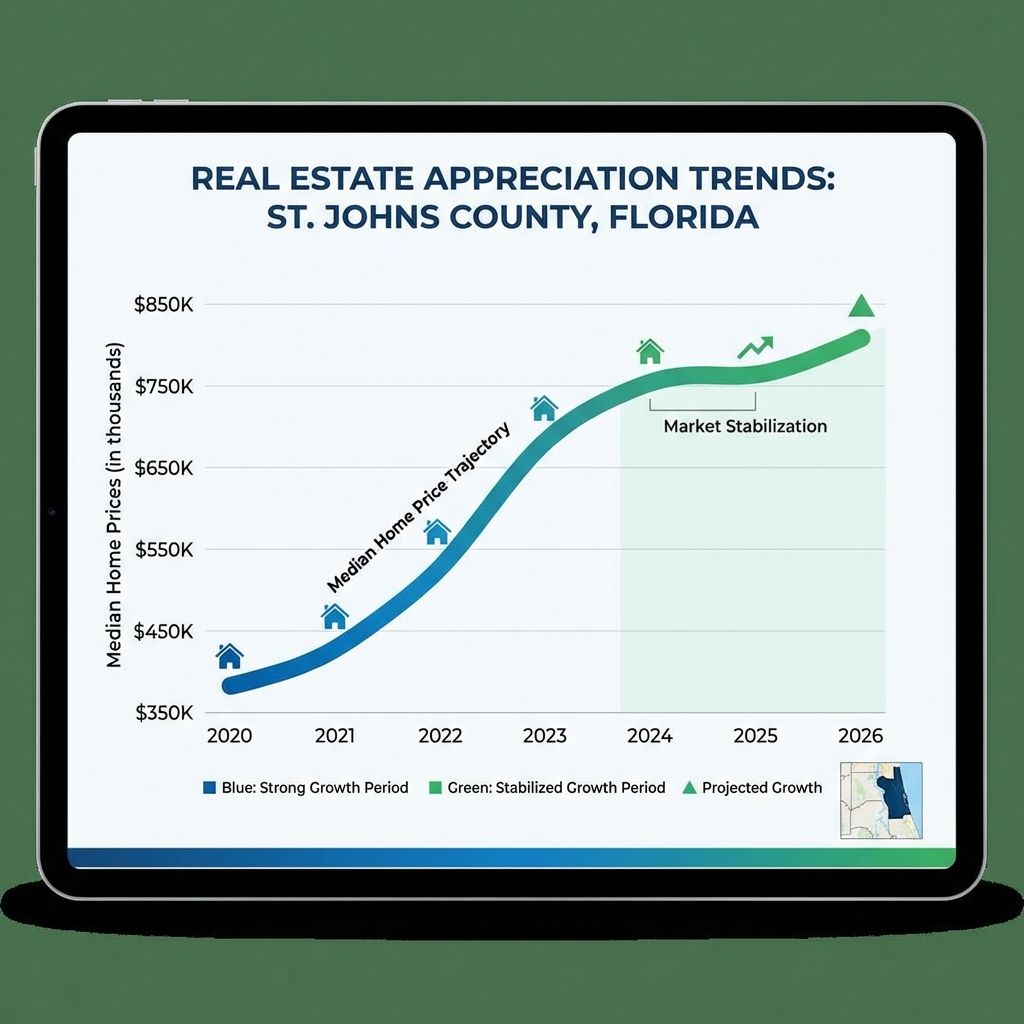
2020-2022: The Boom Years
The pandemic-era market saw unprecedented appreciation in St. Johns County:
- Median prices increased 50%+ from early 2020 to peak 2022
- Multiple offers and bidding wars became standard
- Inventory dropped to historic lows (under 1 month in some areas)
- Many properties sold sight-unseen to out-of-state buyers
Investor Reality: Those who bought pre-pandemic saw exceptional returns, but late-2022 buyers paid peak pricing.
2023: The Adjustment
The market recalibrated as interest rates rose:
- Mid-2021 to mid-2023 showed overall price decreases
- Sharp growth resumed after mid-2023
- August 2023 marked stabilization point
Investor Reality: Correction created better entry points for patient investors.
2024-2025: Stabilization [Updated]
The market has found equilibrium:
- August 2024: +3% year-over-year from August 2023
- Prices peaked in April 2024, then declined nearly 5% through July-August
- September 2025: Market stabilized at mid-$480K median for approximately 2 years
- November 2025: Prices down 4.1% YoY, median $465,000
Investor Reality: The correction is largely complete. Current prices reflect sustainable valuations.
Current Market Conditions [January 2026]
Pricing Metrics:
- Median home price: $465,000 (November 2025)
- Year-over-year change: -4.1%
- Price stabilization period: ~2 years at mid-$480K median
Inventory Dynamics:
- Inventory up 50%+ year-over-year in some submarkets
- More negotiation leverage for buyers than any time since 2019
- New construction represents 27% of closed sales
Buyer Composition:
- Cash buyers: 24% of closed sales
- Investor activity remains healthy
- First-time buyers regaining market share
Market Type:
- Balanced to slight buyer’s market in most areas
- Luxury segment softened more than entry-level
- $200,000-$500,000 range remains most competitive
Investment Strategies by Profile
Buy and Hold (Long-Term Rental)
Best Price Points:
- $250,000-$400,000 single-family homes offer strongest cash flow
- Town-homes in master-planned communities ($275,000-$350,000) provide professional tenant appeal
Target Neighborhoods:
- Durbin Crossing (family renters, school proximity)
- St. Johns (Mixed areas near employment centers)
- Palencia (premium rents, appreciation potential)
Expected Performance:
- Gross yields: 6-8% on properly priced properties
- Net yields after expenses: 4-6%
- Appreciation expectation: 3-5% annually long-term
Learn More: Jacksonville Rental Market Investment Guide
Appreciation Play
Where Growth Is Projected:
- Nocatee expansion areas (Twin Creeks, Valley Ridge)
- World Golf Village redevelopment zone
- St. Johns Town Center peripheral areas
New Development Drivers:
- First Coast Expressway access improvements
- School district capacity expansions
- Commercial development following rooftops
Timeline Expectation:
- 3-5 year hold minimum for appreciation strategy
- Best for investors with patience and low leverage
Builder Incentives Strategy
Current Opportunity:
- Rate buy-downs as low as 3.99% from major builders
- Closing cost credits of $10,000-$25,000
- Upgrade packages valued at $20,000-$50,000
Strategy:
- Leverage builder incentives to offset market softness
- Lock in below-market financing
- Choose inventory homes for fastest occupancy
Consider: Short-Term vs. Long-Term Rentals for rental strategy guidance.
Best Areas for Investment
Emerging Neighborhoods:
- Nocatee Village (new sections with builder incentives)
- RiverTown (growing amenity package)
- Shearwater (value positioning)
Established Performing Areas:
- Durbin Crossing (proven rental demand)
- Julington Creek (appreciation history)
- Palencia (premium segment)
New Construction Opportunities:
- Twin Creeks in Nocatee
- Valley Ridge at Nocatee
- RiverTown expansion
Financial Considerations
Expected Returns
Conservative Scenario (2026-2030):
- Appreciation: 2-4% annually
- Cash flow: 3-5% net yield
- Total return: 5-9% annually
Moderate Scenario:
- Appreciation: 4-6% annually
- Cash flow: 4-6% net yield
- Total return: 8-12% annually
Expenses to Factor
Property Taxes:
- Non-homestead rate: Approximately 1.8-2.2% of assessed value
- No Save Our Homes cap for investment properties
- Budget for annual increases
Insurance Realities:
- Florida insurance market remains challenging
- Budget $3,000-$6,000+ annually for single-family
- Newer construction commands lower premiums
- Flood insurance if applicable
Property Management:
- Professional management: 8-10% of gross rent
- Leasing fees: 50-100% of first month’s rent
- Maintenance reserves: 5-10% of gross rent
Use our Mortgage Calculator to model investment scenarios.
Risks and Challenges
Insurance Costs Rising:
- Florida insurance market volatility continues
- Some carriers exiting market
- Mitigation: Choose newer construction, maintain updates
Inventory Increases:
- More competition from investors selling
- Rental market supply increasing
- Mitigation: Focus on quality properties in desirable areas
Interest Rate Sensitivity:
- Cash flow margins tighter at current rates
- Refinancing strategy may be necessary
- Mitigation: Conservative leverage, rate assumptions
Current Opportunities [2026 Update]
Builder Incentives:
- Historic levels of builder willingness to deal
- Rate buy-downs making cash flow feasible
- Inventory homes offer immediate occupancy
Negotiation Leverage:
- First time since 2019 buyers have meaningful power
- Price reductions and seller concessions available
- Inspection and due diligence periods respected
Motivated Seller Situations:
- Job relocations creating urgency
- Estate sales and inherited properties
- Rate-locked sellers needing to move
Frequently Asked Questions
Related Resources
- Jacksonville Rental Market Investment Guide
- Short-Term vs. Long-Term Rentals in Northeast Florida
- Mortgage Calculator - Investment property analysis
- St. Johns County Economic Development - Official growth data
- BiggerPockets Florida Market Forums - Investor community insights
Ready to Invest in St. Johns County?
St. Johns County’s investment fundamentals-population growth, top schools, quality of life, and tax advantages-remain compelling. The current market offers entry points that weren’t available during the pandemic boom.
Whether you’re pursuing cash flow, appreciation, or a balanced strategy, this market rewards informed investors who understand local dynamics.
Contact me to discuss investment opportunities in St. Johns County. With deep local knowledge and investor-focused service, I’ll help you find the right property for your portfolio.